Resources

Policy Briefs

Organized by published date and focus area

CAPE-Youth has produced a number of policy briefs on key topic areas to guide state policymakers in better supporting youth and young adults with disabilities in their transitions to employment and/or post-secondary education. These include:

Policy Briefs-organized by published date and focus area

Introduction: CAPE-Youth has produced a number of policy briefs on key topic areas to guide state policymakers in better supporting youth and young adults with disabilities in their transitions to employment and/or post-secondary education. These include:

Each brief should have a description below, they should be able to download the brief or read it in the browser–>

Fostering Financial Empowerment for Youth and Young Adults with Disabilities-

Description: This brief provides policy considerations that help Y&YADs and their families foster economic self-sufficiency through financial literacy and independence. These strategies can reduce financial pressures for Y&YADs as they transition to employment and adulthood.

File: 2023_CAPE_Y_FinancialEmpowerment_Final 

Leveraging State Policy to Support Positive Mental Health and Employment for Youth with Marginalized Racial Identities

Description: This document provides policy considerations for improving mental health service delivery for youth with marginalized racial identities through cultural responsiveness, health care access and workforce supports. These considerations were drawn from a virtual roundtable hosted in collaboration with the White House Office of Public Engagement.

File: FINAL-Minority-Mental-health-employment_Short-Brief 

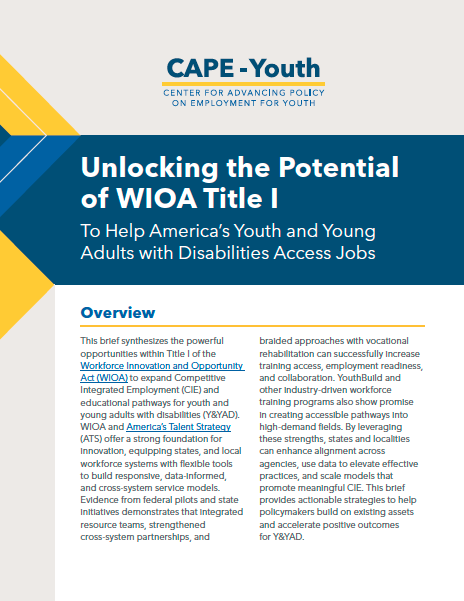
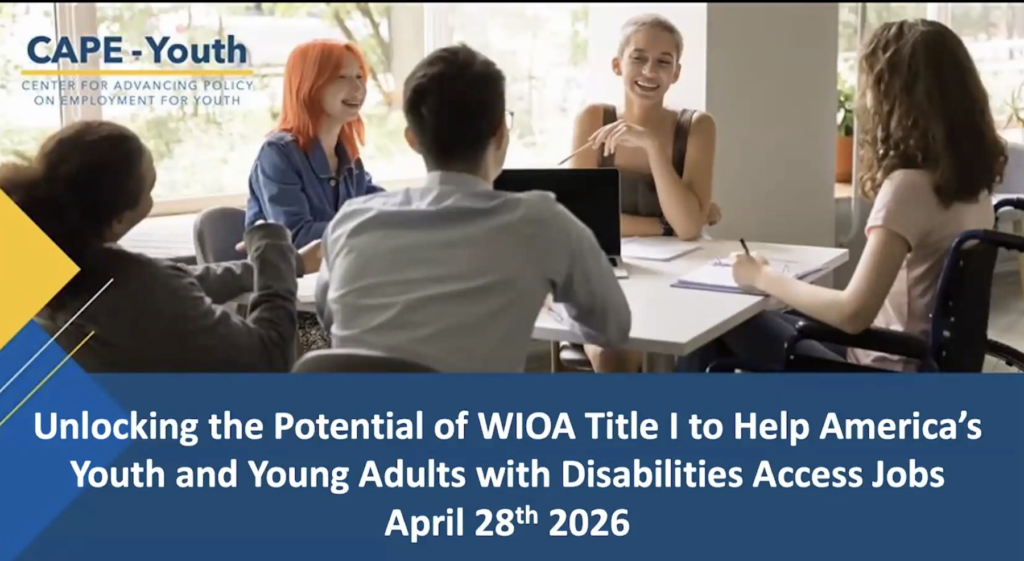
Unlocking the Potential of WIOA Title I

Description: This brief outlines how policymakers and workforce practitioners can enhance their states’ efforts in implementing Workforce Innovation and Opportunity Act (WIOA) Title I programs and services to better serve youth and young adults with disabilities.

File: WIOA_Brief_FINAL_9-6

Transition Services for Justice-Involved Youth and Young Adults with Disabilities: Rehabilitation and Recovery Practices

Description: This brief describes how rehabilitation and recovery interventions can help states improve long-term workforce opportunities for justice-involved Y&YADs, including youth with pre-existing mental and behavioral health needs.  

File: 2023_CAPEYouth_JusticeYouth-RR-Brief-_508

Improving Transition Services for Youth and Young Adults with Disabilities through Braided Funding

Description: Federal initiatives fund key transition, and employment supports for youth and young adults with disabilities (Y&YAD). These efforts include Pre-Employment Transition Services (Pre-ETS)—funded by the Workforce Innovation and Opportunity Act (WIOA), and Career and Technical Education (CTE)—funded by the Strengthening Career and Technical Education for the 21st Century Act (Perkins V). They share common goals but are housed in different federal and state agencies and have varying priorities, outcome expectations and requirements.

File: 2023_CAPE_Y_BraidedFunding_508

Guideposts for Success: States Engaging Employers through Policy

Description: First released by the U.S. Department of Labor’s Office of Disability Employment Policy (ODEP) in 2005, the Guideposts for Success sought to answer the central question, “What do all youth need to make a successful transition to adulthood?” This first-of-its-kind policy framework provided policymakers and practitioners with an evidence-based guide to foster improved education and employment outcomes for youth and young adults with disabilities (Y&YADs).

File: 2023_CAPE_Y_Guideposts_StatesEngagingEmployers_508 

Addressing the Needs of Youth with Disabilities and Other Intersecting Identities: State Strategies for Program Design

Description: This brief is the second part of a two-part series; it focuses specifically on how states can design programs, policies and services to meet the needs of Y&YADs with intersecting identities. A companion brief discusses how states can implement the programs and policies they have developed.

File: 2023_CAPE_Y_Intersectionality_FINAL 

Guideposts for Success: Framework for the Future

Description: This document outlines five evidence-based activities that contribute to better transition incomes for Y&YADs. It therefore serves as a framework for policymakers and practitioners to consider in developing policies and programs that support Y&YADs in their transitions to employment or post-secondary education.

File: 2022_CAPE_Framework_APR-Update.pdf


Transition Activities and Services for Justice-Involved Youth and Young Adults with Disabilities

Description: This document provides policy considerations for improving assistance to justice-involved Y&YADs by implementing comprehensive support and services within the education, employment and justice systems. These considerations were developed based on a roundtable hosted by the White House Office of Public Engagement.

File: Justice-Youth-2-Pager-FINAL

Expanding Apprenticeships as a Career Pathway for Youth and Young Adults with Disabilities

Description: This brief provides state strategies to expand inclusive apprenticeships as a way to increase labor force participation rates and lower unemployment rates for Y&YADs. By creating and fostering accessible and inclusive apprenticeships, states can increase opportunities for Y&YADs and encourage economic growth.

File: Final-PDF-UA-Accessible-CAPE-Youth-Apprenticeship-Brief-March-2022

Addressing the Needs of Youth with Disabilities and Other Intersecting Identities: State Strategies for Program Implementation

Description: This brief discusses how states can implement programs to meet the unique needs, and leverage the unique strengths, of Y&YADs who have other intersecting identities (e.g., who belong to a racial minority group or who have involvement with the justice system).

File: Addressing-the-Needs-of-Youth-with-Disabilities-and-Other-Intersecting-Identities-State-Strategies-for-Program-Implementation

Promoting and Maintaining Career and Technical Education for Students with Disabilities: State Strategies Developed During the COVID-19 Pandemic

Description: This brief describes adaptations used by states to respond to challenges that students with disabilities face in participating in and completing career and technical education (CTE) in general and as a result of the COVID-19 pandemic.

File: CAPE_Youth_CTEBrief 


Trauma Informed Policy for Youth: Structuring Policies and Programs to Support the Future of Work

Descriptions: This brief outlines how states can implement trauma-informed practices into their workforce and other youth-serving systems to facilitate the recovery of youth and young adults with disabilities from trauma that they experience (including as a result of the COVID-19 pandemic) and to mitigate the effects of that trauma on their employment outcomes.

File: CAPE_Youth_TraumaInformedPolicyforYouth

Improving Mental Health Service Delivery Including Coordinated Specialty Care for Youth with a First Episode of Psychosis

Description: This brief indicates how elements of coordinated specialty care service delivery, including supported employment and education, can be funded using traditional sources and alternative options to support youth experiencing a first episode of psychosis and contribute to their long-term success (including around employment).

File: CY_Mental_Health_v9

Employment of Youth and Young Adults with Disabilities in a Recovering Economy: Lessons from the Great Recession and Considerations for Policymakers Today

Description: This brief outlines state-level strategies policymakers and program administrators can utilize to support youth and young adults with disabilities in securing employment and reemployment throughout and following the COVID-19 economic recession, including capitalizing on federal funds and increasing access to employment services.

File: CAPE-Youth_COVID_Brief

Bottom Page Language Acknowledgement: CAPE-Youth recognizes the importance of language within the disability community. Individuals and specific groups have different preferences on how and what language is used to describe them in relation to their disability. CAPE-Youth publications will use person-centered language. When discussing an individual or certain groups within the disability community, CAPE-Youth will use the language preferred by that individual or group. When that information is unavailable, CAPE-Youth will use person-first language.

Webinars organized by published date

Fostering Financial Empowerment for Youth and Young Adults with Disabilities

This brief provides policy considerations that help Y&YADs and their families foster economic self-sufficiency through financial literacy and independence. These strategies can reduce financial pressures for Y&YADs as they transition to employment and adulthood.

Leveraging State Policy to Support Positive Mental Health and Employment for Youth with Marginalized Racial Identities

This document provides policy considerations for improving mental health service delivery for youth with marginalized racial identities through cultural responsiveness, health care access and workforce supports. These considerations were drawn from a virtual roundtable hosted in collaboration with the White House Office of Public Engagement.

Unlocking the Potential of WIOA Title I

This brief outlines how policymakers and workforce practitioners can enhance their states’ efforts in implementing Workforce Innovation and Opportunity Act (WIOA) Title I programs and services to better serve youth and young adults with disabilities.

Transition Services for Justice-Involved Youth and Young Adults with Disabilities: Rehabilitation and Recovery Practices

This brief describes how rehabilitation and recovery interventions can help states improve long-term workforce opportunities for justice-involved Y&YADs, including youth with pre-existing mental and behavioral health needs.

Improving Transition Services for Youth and Young Adults with Disabilities through Braided Funding

Federal initiatives fund key transition, and employment supports for youth and young adults with disabilities (Y&YAD). These efforts include Pre-Employment Transition Services (Pre-ETS)—funded by the Workforce Innovation and Opportunity Act (WIOA), and Career and Technical Education (CTE)—funded by the Strengthening Career and Technical Education for the 21st Century Act (Perkins V). They share common goals but are housed in different federal and state agencies and have varying priorities, outcome expectations and requirements.

Guideposts for Success: States Engaging Employers through Policy

First released by the U.S. Department of Labor’s Office of Disability Employment Policy (ODEP) in 2005, the Guideposts for Success sought to answer the central question, “What do all youth need to make a successful transition to adulthood?” This first-of-its-kind policy framework provided policymakers and practitioners with an evidence-based guide to foster improved education and employment outcomes for youth and young adults with disabilities (Y&YADs).

Addressing the Needs of Youth with Disabilities and Other Intersecting Identities: State Strategies for Program Design

This brief is the second part of a two-part series; it focuses specifically on how states can design programs, policies and services to meet the needs of Y&YADs with intersecting identities. A companion brief discusses how states can implement the programs and policies they have developed.

Transition Activities and Services for Justice-Involved Youth and Young Adults with Disabilities

This document outlines five evidence-based activities that contribute to better transition incomes for Y&YADs. It therefore serves as a framework for policymakers and practitioners to consider in developing policies and programs that support Y&YADs in their transitions to employment or post-secondary education.

Expanding Apprenticeships as a Career Pathway for Youth and Young Adults with Disabilities

This brief provides state strategies to expand inclusive apprenticeships as a way to increase labor force participation rates and lower unemployment rates for Y&YADs. By creating and fostering accessible and inclusive apprenticeships, states can increase opportunities for Y&YADs and encourage economic growth.

Addressing the Needs of Youth with Disabilities and Other Intersecting Identities: State Strategies for Program Implementation

This brief discusses how states can implement programs to meet the unique needs, and leverage the unique strengths, of Y&YADs who have other intersecting identities (e.g., who belong to a racial minority group or who have involvement with the justice system).

Promoting and Maintaining Career and Technical Education for Students with Disabilities: State Strategies Developed During the COVID-19 Pandemic

This brief describes adaptations used by states to respond to challenges that students with disabilities face in participating in and completing career and technical education (CTE) in general and as a result of the COVID-19 pandemic.

Trauma Informed Policy for Youth: Structuring Policies and Programs to Support the Future of Work

This brief outlines how states can implement trauma-informed practices into their workforce and other youth-serving systems to facilitate the recovery of youth and young adults with disabilities from trauma that they experience (including as a result of the COVID-19 pandemic) and to mitigate the effects of that trauma on their employment outcomes.

Improving Mental Health Service Delivery Including Coordinated Specialty Care for Youth with a First Episode of Psychosis

This brief indicates how elements of coordinated specialty care service delivery, including supported employment and education, can be funded using traditional sources and alternative options to support youth experiencing a first episode of psychosis and contribute to their long-term success (including around employment).

Employment of Youth and Young Adults with Disabilities in a Recovering Economy: Lessons from the Great Recession and Considerations for Policymakers Today

This brief outlines state-level strategies policymakers and program administrators can utilize to support youth and young adults with disabilities in securing employment and reemployment throughout and following the COVID-19 economic recession, including capitalizing on federal funds and increasing access to employment services.

Scroll to Top